I acknowledge that I am on the land of the Bunurong people, and pay respects, as always, to the traditional owners, elders and the creative practice that has taken place over thousands of years. Sovereignty was never ceded.
Thank you to Kate Barber and MUMA for the invitation to respond to this exhibition. I am so pleased to return to MUMA to take part in this conversation, for an artist I greatly respect at a place I continue to hold dear. And where I have very fond memories of working together with you, Kate. It’s lovely to be part of your final program.
—
When I began to think through the encounter between Paul’s textiles and photographs in this exhibition, I was immediately drawn back in time, to certain origin stories in his practice. To certain arresting, and enduring, memories I have of Paul’s work over two decades.
This was an instinctive, unguided train of thought – indicitive of, perhaps, a desire to foreground, to lay foundations, to make sense of. To art historicise. A desire to turn survey into retrospective.
The desire we might have, (or I have), when confronted with distilled and profound beauty such as what we see in these woven sheets, suspended in three quietly powerful moments amid the enduring love story that is Chamber music, to somehow intellectualise the deep wells of emotion that they draw forth.
Or perhaps, more accurately, I was taking myself on a journey that is more grounded in materiality, or in the space of the lived (and loved) body than the space of the mind. Spaces that are more difficult to articulate, explain, or parse.
Spaces that, I’ve begun to wonder, can only be articulated through that materiality, or that body, and through the dance they perform between them in this work.
Across the years of his practice, Paul has reached into, and represented, deep vulnerabilities – vulnerabilities that are very often particular to the encounter with an intimate other.
He has also – sometimes in the very same moment – enclosed, absented, hidden and veiled. I have felt both deeply drawn to, and at once removed, from his subjects. The works can be both mirror and mystery, which is why they are so compelling.
I think that Paul’s relationship with, and attention to, his chosen mediums of photography, and (relatively) more recently, textiles, has a lot to do with that. I think that what is happening in these spaces at MUMA is a beautiful, complex culmination of that relationship.
Let me recall two origin stories.
In his photographs of Cinema curtains from around 2004-6, (which some of you may remember), Paul’s lens stared directly at the shimmering, velvety surfaces of these curtains, fully closed, in the time between feature film screenings. Beautiful undulating colour fields. In some, we might make out the geometry of the blank screen behind the shimmer, waiting to receive its projections. In others, footlights on heavy curtains emphasised their opaque and undulating form. A non-disclosure.
Then, in 2010, there was an arresting seriesof untitled photographs of couples in bed, limbs entwined, pillows shared, rumpled sheets resting lightly on naked skin.
On these C type prints, Paul had undertaken certain actions, making a single, diagonally vertical fold that compressed his subjects together, and sewing small areas to hold the print in place. These actions brought forth the material quality of the photographic print, the photo speaking … A kind of simultaneous crumpling and slicing. And a delicate stitching together.
The result was a merging of bodies, but in strange ways – in one photograph, two faces becoming one; in another, the right hands from each partner performing a strange doubling onto a torso – self and other, gently holding on (this was Paul and Peter, in the blue bed sheets we see in Chamber music which he’d already begun, in 2009).
In another, a body disappeared from view almost entirely, into the other.
I thought of these photographs when I read the lyrics of the Jacques Brel song Paul has drawn from in the title of this exhibition –
Laisse-moi devenir
L’ombre de ton ombre
L’ombre de ta main
Let me become
The shadow of your shadow
The shadow of your hand
I also thought of the question these photographs raised in me all those years ago:
‘Are these photographs, turned in upon themselves, depictions of love?’ I concluded then that ‘we don’t know. In front of them, we are pulled towards this human intimacy whilst being reminded that we are entirely outside of it.’
In these earlier photographs, the fold of the photograph worked in tandem with the rumpled drape and fold of the bedding Paul’s subjects were resting in. The action of the fold, it’s concealment, also recalled the non-disclosure of the cinema curtain. Keeping something private and unknowable.
—
Let’s bring ourselves back into the gallery, to the present, where we are in the space of l’ombre de ton ombre. The trajectory of the Chamber music photographs – this delicate, heartfelt, horny, tender, interior unfolding of moments from Paul’s relationship with Peter since 2009 – traverses four spaces. Across its small and large scale prints, (just a few of the hundreds that comprise the ongoing series) Chamber music is at first glance open, revealing, full of candour, incidental.
In many of the photographs, much is left to chance. The camera sees what it finds. It’s a third party, looking in, upon. And what it finds may be unreadable, awkward. Opaque. The camera struggles to articulate. Or close, so close. Or it might be an embrace viewed through an open door, from a distance.
There are quietly composed observations of a domestic still life, a stained bed. Rumpled tissues. Condoms. A deli platter. An empty plate. In others, the murkiness of sex. A flash of light. A strange perspective. In others still, an engagement with the outside world, beers on a beach at night.
Aftermaths, anticipations. Some writ large, some tiny and intimate.
—
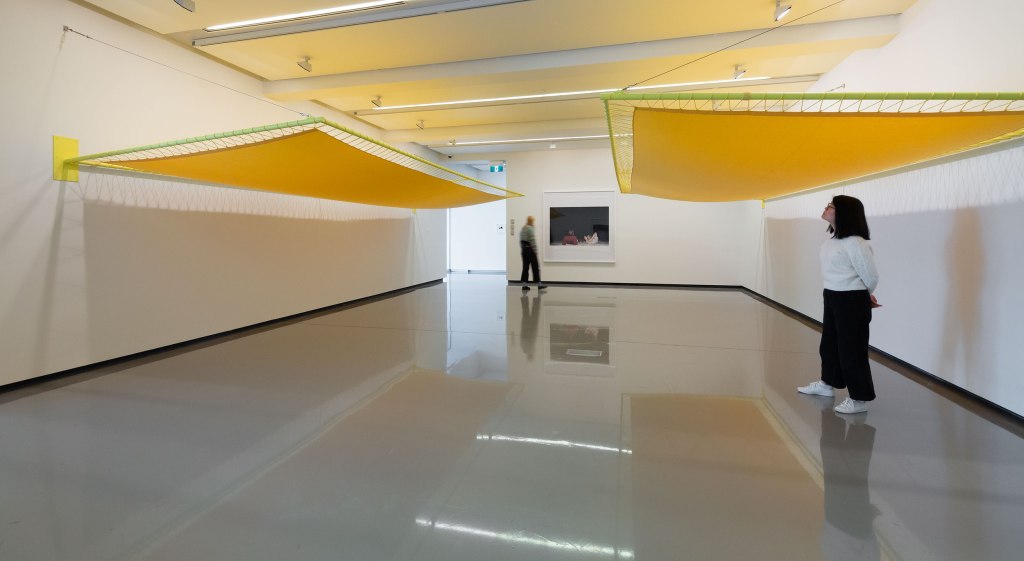
Don’t stand by my side, stand inside 2023, installation view, L’ombre de ton ombre, Monash University Museum of Art, 2023. Photo Christian Capurro.
Also in the gallery, Paul’s suspended, hand woven cotton sheets engage in a series of relationships – to each other, to the Chamber music photographs, and to us.
You can lose yourself in front of these suspended sheets, as you stand before their expanse, eyes tracing their mass, attending to the tiny detail of the thread, it’s imperfections.
Don’t stand by my side, stand inside might shelter you like a canopy, its warm yellow reflected glow enveloping you. Here, the sheets sag, hammock-like, two resting points ready for two bodies resting, or falling.
Others are tautly hung abstractions. Like Rothko, or Albers, meeting the bedroom. In the deep crimson Lungs in the front gallery they are strident bellows, the four sheets gathering to form their own interior space, communing amongst themselves.
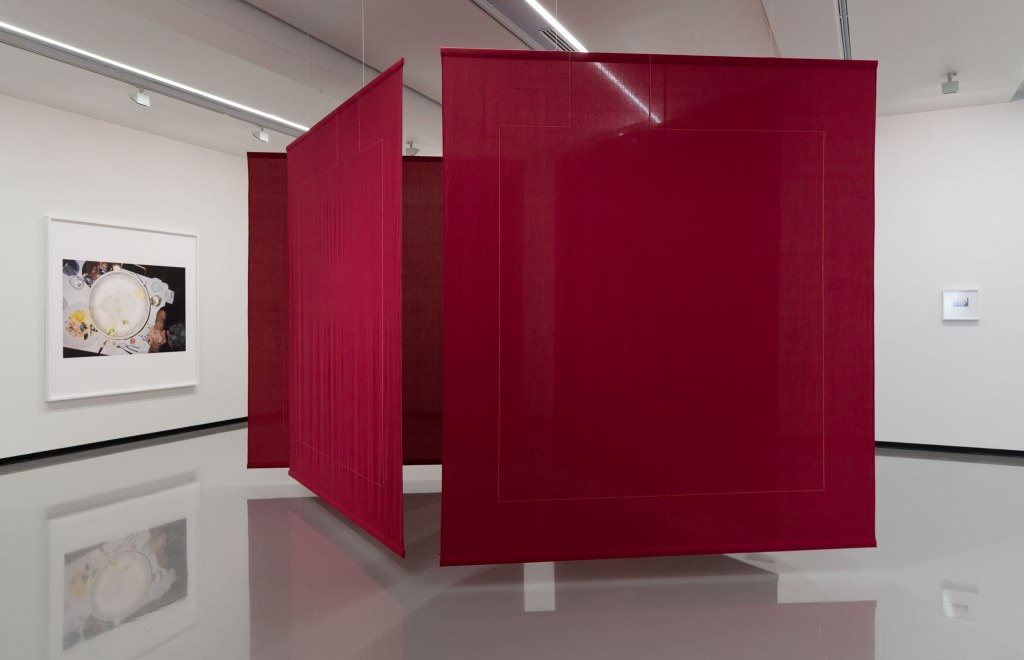
Lungs 2023, installation view, L’ombre de ton ombre, Monash University Museum of Art, 2023. Photo Christian Capurro.
Encountering these sheets, it is also easy to imagine Paul at the loom, and the time spent there. Even without a deep knowledge of weaving, the thinness of the thread, and the expansiveness of the sheet tells us the hours are long, the calculations complex. The thin lines woven through are a precise continuum, tracing their own delicate geometries. The weft thread a single line pressed against itself as the weaving takes place.
Strength is gained through the weave.
Is a human relationship over time more vulnerable and fragile than the woven thread, with its strengthening weave? Or does a human relationship over time become stronger, the thread weaker? How does each wear out, stay together? Standing under Don’t stand by my side, stand inside, I see a threadbare patch, and wonder: would it hold the body securely? Is it strong enough? Are we strong enough?
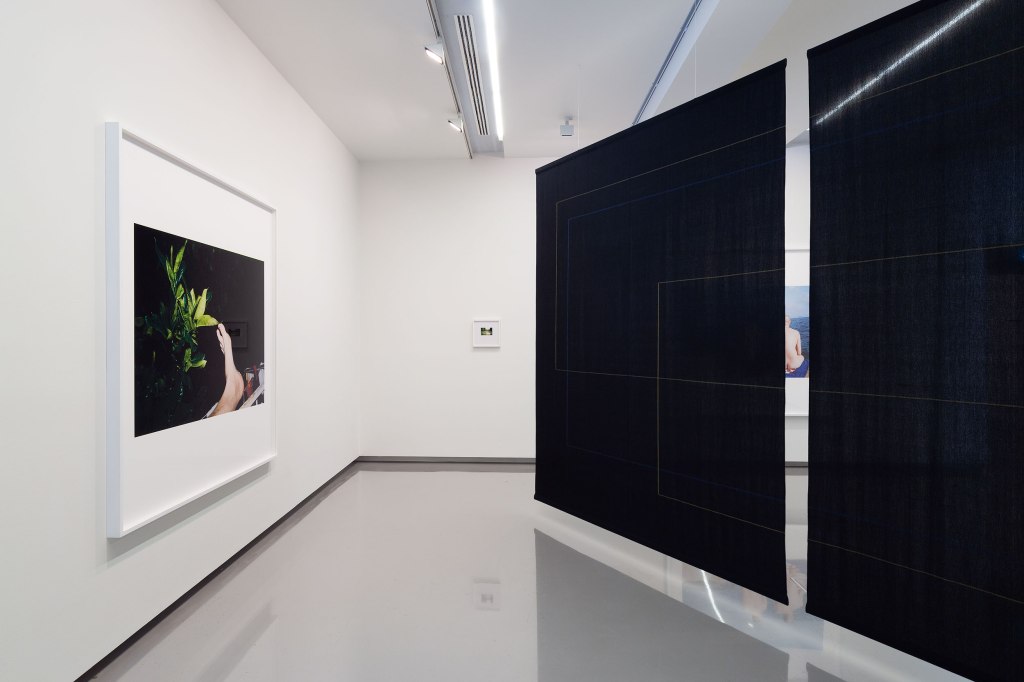
Untitled from the series Chamber Music 2009- and Binary Star 2023, installation view, Monash University Museum of Art, 2023. Photo Christian Capurro.
Standing before Binary star, my eye tracing the intersecting, coloured lines across this pair of inky-blue sheets, I see from the corner of my eye Paul’s large photograph of a foot resting on a washing line. Its large and awkward, the foot stunned by the camera flash. It’s a really strange image – uncanny, somewhat impenetrable, but it’s black sky emphasises the photograph’s edge and the deep space within it. Slowly, I come to read Paul’s woven lines as interlocked geometries echoing that limited, yet expansive, space.
Time is then somehow stilled, paused, by the woven sheet and the photographic sheet. Bounded. These hanging rectangles in space, the lines woven through them, reflecting the contained space of the photographic frame. The geometry of all four sides, repeated, defined by selvage and viewfinder. An echo of the shared space of the bed. Surely here’s only so much to be held within such spaces. Or, maybe they hold the universe.
I take a few steps and Binary Star becomes a sharp edge, a blade bisecting the room, splitting the space between two photos on opposing walls. A cut, a slice, an interruption.
But this move has also revealed a beautiful photo of Paul and Peter sitting naked on a beach, looking out to sea.
I think, then, of the weave of a shared life, and what it takes to share that resolve, to commit to loving, to lusting. To caring.
What that looks like, might well be this.
 Kyla McFarlane